10 FGA tasksReal clinical tasks; a clinician rates 0–30
How it works · Standard clinical gait assessment
A camera can see more than a stopwatch.
Using the Functional Gait Assessment (FGA) as a concrete example, MedMeters is designed to measure selected gait characteristics, help clinicians review challenging tasks and prepare the chart note faster.
Design concept, not live analysis. Published FGA: 10 tasks, clinician-rated 0–3 each, 30 points total. Protocol reference ↗
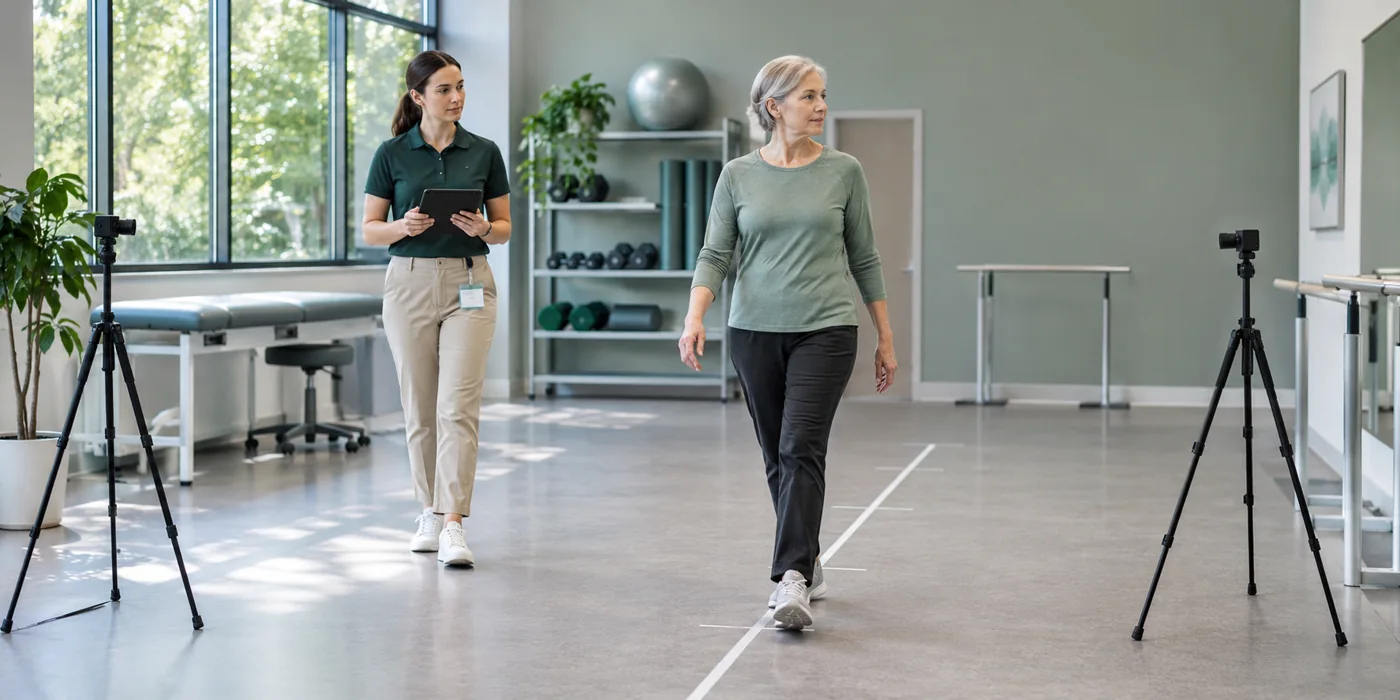
ILLUSTRATIVE CV WORKFLOWFunctional Gait AssessmentWalking speed · step placement · head turns
Quantified movementCamera adds gait and turning descriptors
Review-ready outputDraft chart data; not an autonomous score
01 / Established clinical protocol
Ten real tasks. A clinician-rated 0–30 result.
The FGA assesses dynamic balance while walking. A marked 6 m (20 ft) path, an obstacle and stairs are used across the published 10-item procedure. MedMeters would capture selected measurements without changing the clinician's responsibility for the official score.
10Standardized tasks
6 mMarked walkway for walking items
0–30Clinician-rated total score
5–10 minTypical administration estimate*
01Level walking
02Change in gait speed
03Horizontal head turns
04Vertical head turns
05Pivot turn
06Step over obstacle
07Narrow-base walking
08Eyes-closed walking
09Backward walking
10Stairs
*Typical administration estimate from NINDS CDE. All tasks require appropriate clinical supervision and safety assessment. Rehabilitation Measures Database ↗ · APTA FGA overview ↗
02 / Why the camera matters
Quantify what is difficult to judge by eye.
Select an FGA task below. These are illustrative metrics that calibrated camera analysis could provide for clinical review — not automatically generated official FGA scores.
Conceptual overlay — not actual model output
Walking trajectory Calibration lane
FGA item 3 · Horizontal head turns
Does the patient stay on course while looking sideways?
The clinician watches balance and gait quality. A calibrated camera system could quantify changes in velocity and lateral deviation while the head turns.
Walking speed0.77 m/s
Lateral deviation18 cm
Clinician confirms head-turn performance and assigns official item score.
All numbers are fictional and demonstrate a proposed interface. Accuracy, visibility and camera requirements remain unvalidated for MedMeters.
Published feasibility research, not MedMeters validation
Read the study ↗Darici, Cabak & Wong (2026) tested a three-camera markerless FGA approach. Compared with laboratory motion capture, the system reported R² 0.98 for step length, 0.97 for step width and 0.95 for head speed (validation N=3; clinical demonstration N=5).
03 / The business benefit to test
Reduce total assessment time — not the patient's required test.
Clinical time spent measuring, reviewing and charting can accumulate around the standardized walking tasks. The MedMeters workflow is designed to shorten those surrounding steps while preserving clinical safety and clinician judgment.
TODAY · COMMON MANUAL WORKFLOW
Set up test route and tools
Observe ten tasks and time manually
Estimate deviation and movement patterns
Record item-by-item scores
Find previous results and write the note
MEDMETERS · PROPOSED WORKFLOW
Guided route and calibrated capture setup
Run the same standard walking tasks
Receive draft objective measurements and flags
Clinician confirms scores and exceptions
Approve prefilled comparison and chart note
Primary pilot endpoint
Staff minutes from preparation to saved clinical record, including camera setup, measurement verification and export.
No percentage saving claimed before a measured pilot
04 / Clinician-reviewed outcome
Measurements, score review and a draft note in one place.
The FGA score remains a clinician-rated ordinal result. The example adds exploratory CV parameters so the clinician can investigate which walking tasks changed, while reviewing protocol comparability across visits.
ILLUSTRATIVE REPORT · NO REAL PATIENT
Functional Gait Assessment
Baseline17/30
Current20/30
Change+3 pts
Fictional clinician-rated values. Change alone is not proof of clinical improvement.
1 task event flagged for clinician review
The report includes
- Per-item clinician scores and task observations.
- Proposed camera-derived gait metrics with quality flags.
- Protocol and assistance conditions for repeat visits.
- Who reviewed results, when, and whether score is final.
- Draft EHR note plus patient-friendly summary.
05 / Safety and limitations
Clinician-supervised first. Remote use only after a separate study.
FGA includes challenging balance conditions such as eyes-closed walking, obstacles and stairs. A home or unsupervised version cannot be assumed equivalent to the published protocol. The research prototype used three cameras; a one-phone implementation would require its own evidence.
Trained clinician in control
The clinician selects appropriate tasks, monitors safety, checks potential measurement errors and provides final FGA scores.
Not all tasks can be self-administered
Any future remote workflow requires patient selection, suitable assistance, camera validation and explicit equivalence testing; a remote clinician cannot physically prevent a fall.
Designed to save staff time
Discuss the pilot ↗Less time on measurements and paperwork. More time with patients.
We're looking for clinical design partners to measure if the full workflow actually saves time.