Clinical question
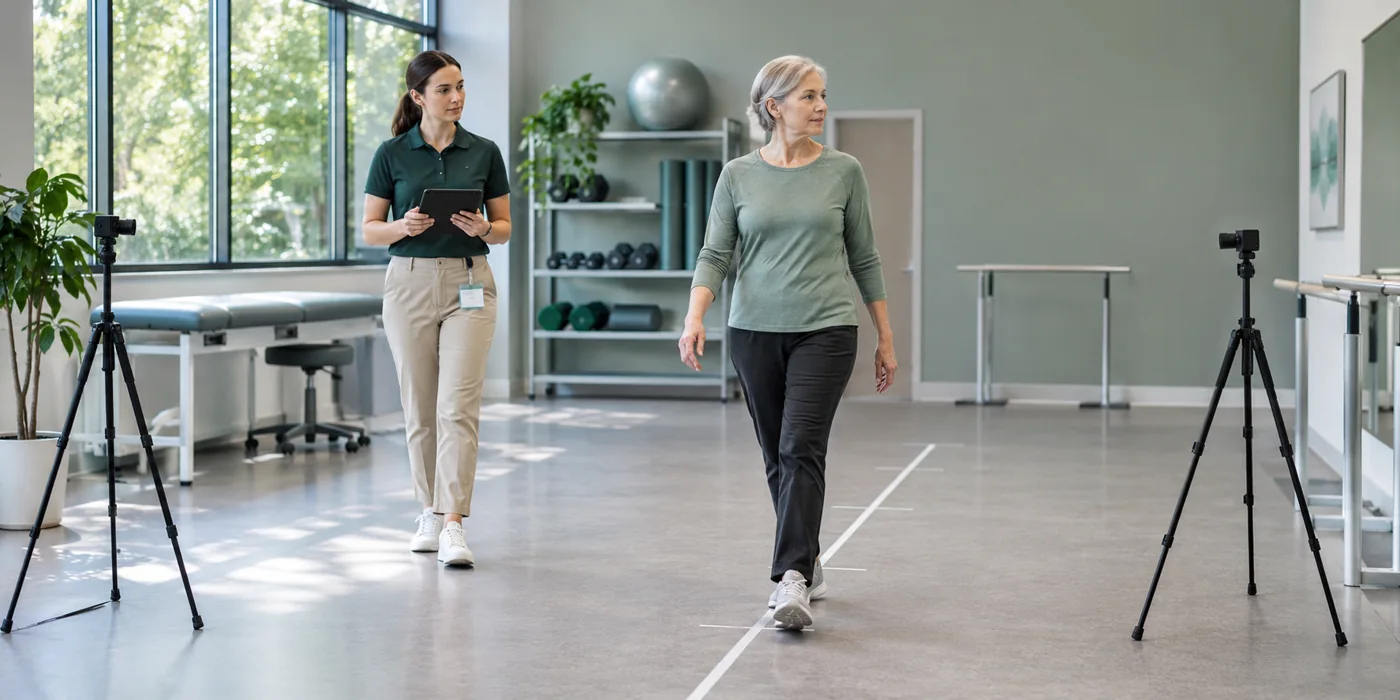
Can ordinary cameras and markerless pose estimation measure aspects of walking that are relevant to the standardized Functional Gait Assessment (FGA)?
Study design
Osman Darici, Chanel Cabak and Jeremy D. Wong developed a three-camera markerless motion-capture setup and compared its measurements against traditional marker-based motion capture in three participants. They also showed feasibility in five older adults performing FGA tasks.
What the researchers found
Reported R² values were 0.98 for step length, 0.97 for step width and 0.95 for head speed compared with the reference system. This supports technical feasibility under the tested conditions, not broad clinical accuracy claims.
Why this matters for MedMeters
FGA has ten clinician-rated tasks, many involving speed control, step placement, head movements and balance. Supplementary camera-derived data could make repeat measurements easier to review and document. Time savings must still be measured from camera setup all the way to the final EHR record.
What this does not prove
The validation cohort was N=3, and the demonstration involved N=5. The study used three cameras. It does not prove that a single smartphone is adequate, that automatic ordinal FGA item scoring is valid, or that clinicians save time. Those would require separate studies and validation.
Darici O, Cabak C, Wong JD (2026). A low-cost markerless motion capture system to automate functional gait assessment: Feasibility study. PLOS ONE 21(6):e0346606.
DOI: 10.1371/journal.pone.0346606 ↗