Measure and review
Choose a standard battery appropriate to injury stage → capture repeated tasks → review side-to-side change and clinical readiness.
Sports rehabilitation often uses repeatable hopping, landing, balance and movement tasks. These require more complex capture than simple counts and should not be converted into injury-risk diagnoses without validation.
Product concept and validation roadmap. No MedMeters measurements are clinically available yet.
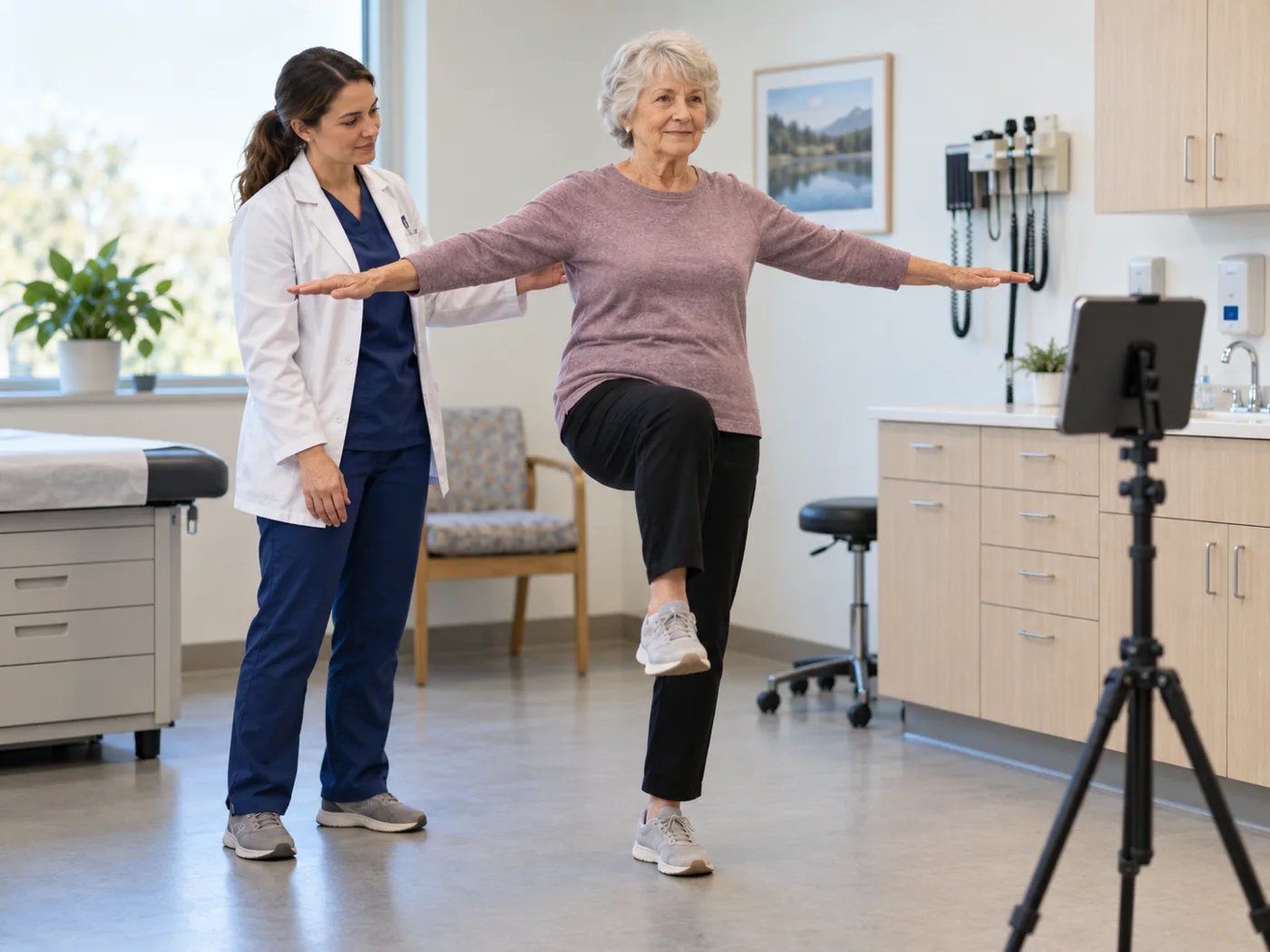
Sports PT · Orthopedic recovery · Return-to-activity. The exact protocol, test equipment and camera requirements matter more than a generic AI movement score.
These are established tests or clinical measurement methods, not a claim that all are currently fully automatable from a single RGB camera.
| Assessment | Source / framework | Potential measurement | Suitable context |
|---|---|---|---|
| Single-Leg Hop for Distance | Functional hop test | Calibrated distance and side asymmetry | Clinic, supervised |
| Triple Hop for Distance | Functional hop test | Total horizontal distance | Clinic, supervised |
| Y-Balance Test | Standardized dynamic balance task | Calibrated reach directions | With apparatus |
| Single-Leg Squat | Functional movement observation | Repetitions and visible movement metrics | Clinician-led |
| Step-Down Test | Functional movement task | Time, count and visible compensation | Clinic / selected follow-up |
Choose a standard battery appropriate to injury stage → capture repeated tasks → review side-to-side change and clinical readiness.
Hopping and balance can carry injury and fall risks. Home self-testing is not a first-release priority.
The software must reject poor-quality captures. Repeated tests should be compared only when protocol version, equipment, assistance and camera conditions are compatible.
Clinic app, selected guided-home follow-up or a healthcare-platform API — all designed around clinician-confirmed measurements and explicit quality metadata.