Measure and review
Record hand dominance and equipment → capture a tabletop task → verify correct transfers or placements → compare with follow-up.
Dexterity tests often already return a simple timed or counted endpoint. Overhead smartphone capture may reduce manual recording while keeping the clinician responsible for correct procedure.
Product concept and validation roadmap. No MedMeters measurements are clinically available yet.
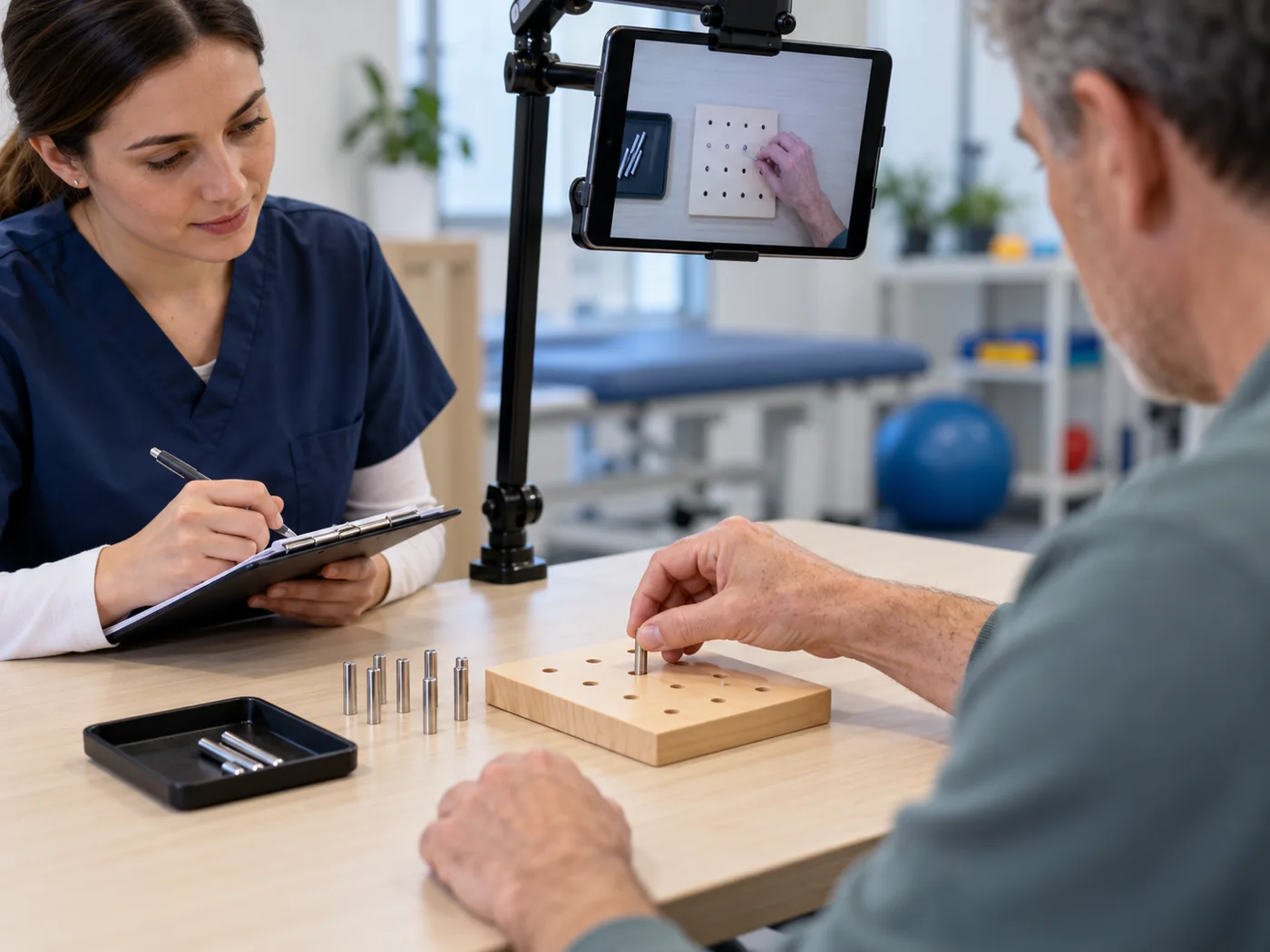
Hand rehabilitation · Dexterity · Upper-limb recovery. The exact protocol, test equipment and camera requirements matter more than a generic AI movement score.
These are established tests or clinical measurement methods, not a claim that all are currently fully automatable from a single RGB camera.
| Assessment | Source / framework | Potential measurement | Suitable context |
|---|---|---|---|
| 9-Hole Peg Test | Standardized hand dexterity test | Completion time for each hand | Standard pegboard needed |
| Box and Block Test | Standardized gross manual dexterity test | Correctly transferred blocks per 60 seconds | Standard apparatus needed |
| Finger Total Active Motion | Hand therapy goniometry | Summed active MCP/PIP/DIP motion | Specialized camera view |
| Wrist flexion / extension AROM | Goniometric assessment | Angular range in degrees | Clinic / selected home |
| Action Research Arm Test | Neuro/upper-limb functional assessment | Task observations for clinician score | Clinician-led |
Record hand dominance and equipment → capture a tabletop task → verify correct transfers or placements → compare with follow-up.
Home tests need the same physical apparatus and setup. The camera cannot replace a grip dynamometer.
The software must reject poor-quality captures. Repeated tests should be compared only when protocol version, equipment, assistance and camera conditions are compatible.
Clinic app, selected guided-home follow-up or a healthcare-platform API — all designed around clinician-confirmed measurements and explicit quality metadata.