Clinical question
The standard 30-Second Chair Stand (30STS) returns one number: full stands in 30 seconds. Can ordinary smartphone video capture additional information about how the movement is performed?
Study design
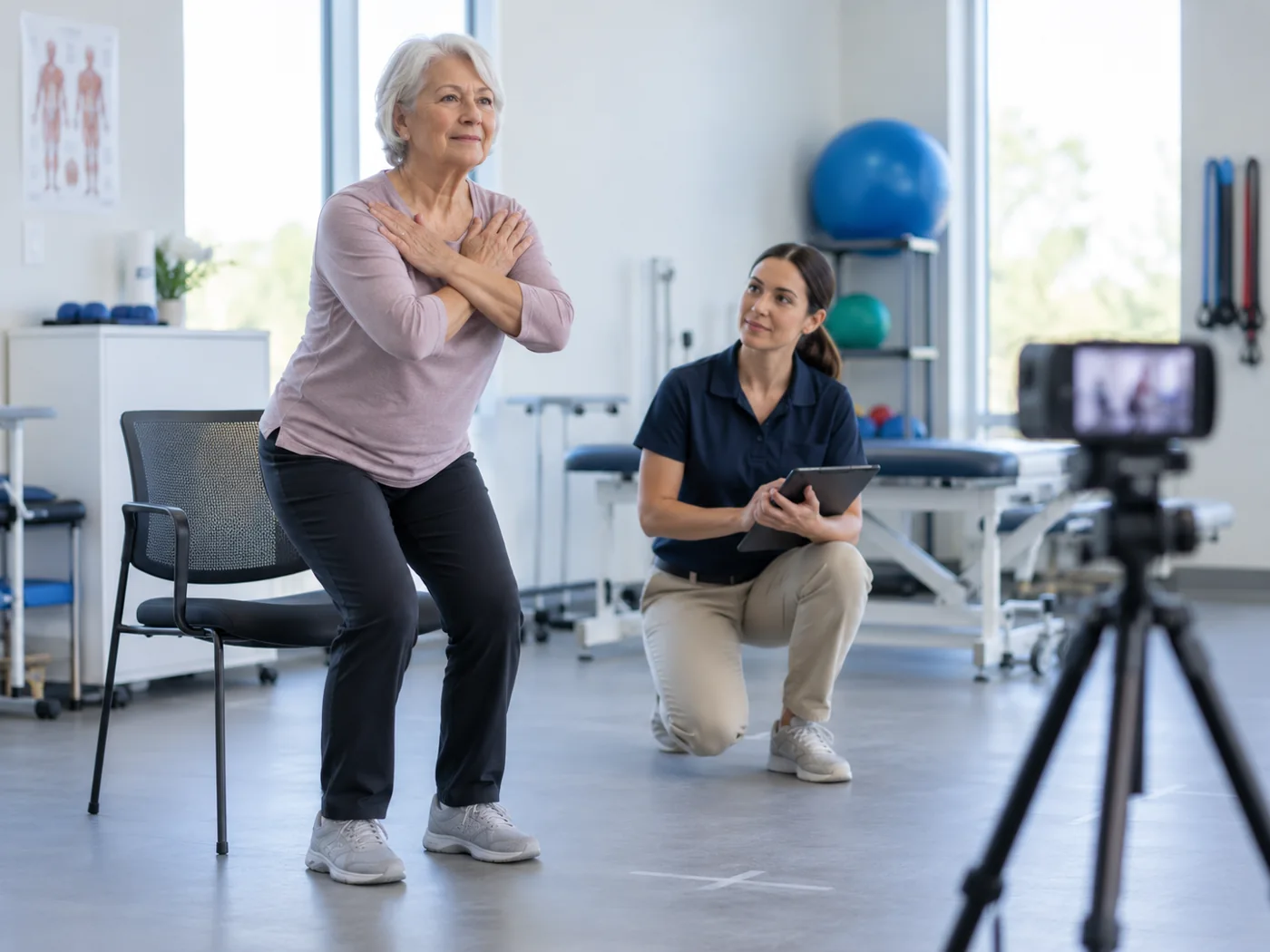
Hsu and colleagues analyzed two 30STS sessions in 32 community-dwelling older adults (18 classified as normal, 14 as weak), recorded about six months apart. Video was acquired with an iPhone 8 at 1080p and 60 frames per second. The phone was placed roughly 2 meters in front of the participant at about hip height; a physical therapist supervised the test.
Keypoint R-CNN estimated 17 body landmarks, from which the researchers reconstructed an estimated center-of-mass trajectory, velocity and other kinematic descriptors. These were analyzed to explore differences in movement patterns beyond repetitions alone.
What was found
Several center-of-mass descriptors differentiated groups within the small study. The researchers reported high internal cross-validated discrimination, but these were research classification results in a 32-person sample, not accuracy for automatic repetition counting in clinical deployment.
Why this is relevant to MedMeters
This study illustrates a plausible single-smartphone capture approach for functional testing. It supports designing a camera-based workflow that records repeatable movements, extracts motion signals and prepares a clinician-reviewable report. It does not imply that every derived metric is already clinically useful.
Limits and unanswered questions
The cohort was small and independently ambulatory; there was no independent external validation cohort or laboratory motion-capture reference. Camera placement, clothing, body size, assistance and test fidelity must be checked before MedMeters can make any accuracy or clinical claims.
Hsu C-Y et al. Quantitative assessment of the 30-second sit-to-stand test using computer vision technology for physical therapists. Journal of NeuroEngineering and Rehabilitation, 2026. DOI: 10.1186/s12984-026-01970-3